Friday, December 21, 2007

Leaving Nepal
My last we eks in Nepal has been spent on saying goodbye to colleagues and friends. Despite the fact that I am happy to leave and am looking forward to moving to Syria and the many new challenges that awaits, it is still sad having to say goodbye to life in Nepal. During the last 18 months I have
  had many good experiences and met many fantastic people.
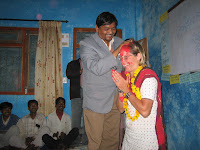
In the two organisations where I worked big traditional parties were held with speeches, tika and mallah (flowers). Steve and I were then in charge of the more western way of parting; party with booze, barbeque and dancing.
 eks in Nepal has been spent on saying goodbye to colleagues and friends. Despite the fact that I am happy to leave and am looking forward to moving to Syria and the many new challenges that awaits, it is still sad having to say goodbye to life in Nepal. During the last 18 months I have
  had many good experiences and met many fantastic people.
In the two organisations where I worked big traditional parties were held with speeches, tika and mallah (flowers). Steve and I were then in charge of
 the more western way of parting; party with booze, barbeque and dancing.
Wednesday, December 19, 2007
Time for change
As some of you might already know the time has come for me to leave Nepal and my job with MS Nepal. In November I got offered a position with UNDP in Syria. I will be based in Damascus working with the UNDP gender section focusing on gender mainstreaming of UNDPs programmes and women's empowerment.
I will leave Nepal in time for Christmas at home, spending most of January in Denmark attending Danida and UNDP courses. Before heading to Damascus in the end of January.
Unlike my other postings I will not be going alone this time but will go together with my boyfriend, Steve. This will be a new and interesting experience for both for us and we are extremely excited about spending the next two years in Syria.
And as always....friends and family are more than welcome to visit
Friday, December 07, 2007
Visit from back home


October and November are known as some of the best months to visit Nepal and I certainly benefitted from this with visits from back home.
The first visitors were my parents who spent almost three weeks here before we all went to Thailand to meet up with my sister and her family.
We had three great weeks in Nepal with lots of good experiences. Though living here I seldom have the time to play tourist and I really enjoyed being able to enjoy the pleasures of Nepal with my parents.
We saw what is supposed to be seen in Kathmandu, went trekking in the Himalayas, saw the birth place of Buddha, went elephant riding and spent some time relaxing in my home in Nepalgunj.
Shortly after parting with my parents the next visitor arrived, my good friend Hans. We went on some crazy white water rafting in the cold waters coming from the mountains of Tibet! Hans turned out to be quite the extreme sport person with Canyon Swing, Paragliding and bike cycle safari followed by a more relaxed elephant ride in the jungle where we managed to disturb two rhinos in the middle of a mating ritual.
It has been great having visitors from back home and I hope for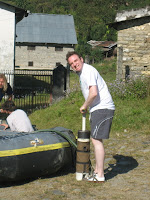 many more in the future….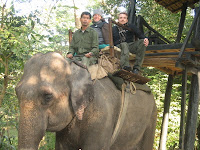
The first visitors were my parents who spent almost three weeks here before we all went to Thailand to meet up with my sister and her family.
We had three great weeks in Nepal with lots of good experiences. Though living here I seldom have the time to play tourist and I really enjoyed being able to enjoy the pleasures of Nepal with my parents.
We saw what is supposed to be seen in Kathmandu, went trekking in the Himalayas, saw the birth place of Buddha, went elephant riding and spent some time relaxing in my home in Nepalgunj.
Shortly after parting with my parents the next visitor arrived, my good friend Hans. We went on some crazy white water rafting in the cold waters coming from the mountains of Tibet! Hans turned out to be quite the extreme sport person with Canyon Swing, Paragliding and bike cycle safari followed by a more relaxed elephant ride in the jungle where we managed to disturb two rhinos in the middle of a mating ritual.
It has been great having visitors from back home and I hope for
 many more in the future….
Thursday, October 18, 2007
Baseline survey
At DWO we have been talking for a while about making a baseline survey. Since my colleagues have no previous experience with this I became the anchor women in this activity.
A baseline survey can be used for many different purposes. Normally, it is made wh en starting a new programme, which is also why we decided to conduct one. In the spring DWO signed a new partnership agreement with MS Nepal and as part of that agreement ten new women’s group were to be formed. The women in these groups will during the coming three years receive training and support from DWO. So before starting the programme it is therefore a good idea to conduct at baseline survey. It will show how the situation of the women is today and once the programme has ended a similar survey will be conducted and it will be possible to get an idea of the changes that has taken place.
MS works according to a principle of inclusion of people on all levels and in order to follow this beautiful principle we quickly decided that long, boring questionnaires would be worthless to us. Instead we decided to use participatory methods:

Household mapping:
Each woman got a piece of paper on which they could ”draw their home”. By using symbols or drawings the women could tell about the number of people in the house, if there were access to toilets, sufficient food, domestic violence, illness, etc. It was a good and fun exercise. The women had the opportunity to discuss with us and each other about the situation in their home and the village.
Daily responsibilities: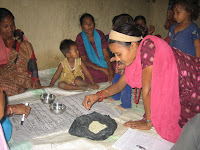
This exercise also focused on the daily life of these women. We had recorded all daily activities such as; domestic work, field work, participation in activities (training, meetings, etc), access to information and so on. Each activity was divided into two categories: male and female. The women would then have to place small beans on respectively male or female depending on who they thought did the work. This exercise also started a lively discussion and the women were very surprised to see how big their work load was compared to that of their men.
Venn diagram:
This last exercise focused on the institutions and organisations the women would contact in order to gain support or help. Depending on knowledge and awareness each organisation was awarded a small or large circle and placed close to or far from the women’s group. In one group a tiny little circle was placed as far away as possible from the group. It turned out it was the local police that was greatly feared by the women.
My colleagues and I spent a lot of time on this exercise. In the office hours were spent discussing and preparing the visit to the women’s group and in the village days were spent conducting the survey. We got an amazingly positive feed back and for me it has been a very interesting task to perform.

A baseline survey can be used for many different purposes. Normally, it is made wh
 en starting a new programme, which is also why we decided to conduct one. In the spring DWO signed a new partnership agreement with MS Nepal and as part of that agreement ten new women’s group were to be formed. The women in these groups will during the coming three years receive training and support from DWO. So before starting the programme it is therefore a good idea to conduct at baseline survey. It will show how the situation of the women is today and once the programme has ended a similar survey will be conducted and it will be possible to get an idea of the changes that has taken place.
MS works according to a principle of inclusion of people on all levels and in order to follow this beautiful principle we quickly decided that long, boring questionnaires would be worthless to us. Instead we decided to use participatory methods:

Household mapping:
Each woman got a piece of paper on which they could ”draw their home”. By using symbols or drawings the women could tell about the number of people in the house, if there were access to toilets, sufficient food, domestic violence, illness, etc. It was a good and fun exercise. The women had the opportunity to discuss with us and each other about the situation in their home and the village.
Daily responsibilities:

This exercise also focused on the daily life of these women. We had recorded all daily activities such as; domestic work, field work, participation in activities (training, meetings, etc), access to information and so on. Each activity was divided into two categories: male and female. The women would then have to place small beans on respectively male or female depending on who they thought did the work. This exercise also started a lively discussion and the women were very surprised to see how big their work load was compared to that of their men.
Venn diagram:

This last exercise focused on the institutions and organisations the women would contact in order to gain support or help. Depending on knowledge and awareness each organisation was awarded a small or large circle and placed close to or far from the women’s group. In one group a tiny little circle was placed as far away as possible from the group. It turned out it was the local police that was greatly feared by the women.
My colleagues and I spent a lot of time on this exercise. In the office hours were spent discussing and preparing the visit to the women’s group and in the village days were spent conducting the survey. We got an amazingly positive feed back and for me it has been a very interesting task to perform.

Sunday, September 23, 2007
Weekend in India
When living only 4 km. from the border I guess you have to go for a visit to the w orld’s biggest democracy.
 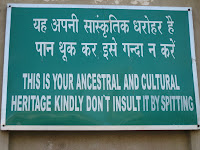 Luckily, I have a good friend, Laura, who lives in Delhi and we had arranged a weekend trip to Lucknow, a city situated about 200 km. from Nepalgunj.
The trip to Lucknow takes 5 hours in a taxi but before that you have to get past the Indian immigration officer. Those of you who have been to India can probably share a story or two about the Indian bureaucracy and the main character would most likely be a guy like the immigration officer at the Nepalgunj border. Once all my personal data has been recorded in different books and on forms, everything from age, family relations, politics and festival needs to be discussed over a cup of the. Until this often hour long ritual has been seen through you can forget about a stamp in your passport.

My theory is that since only about 500 foreigners cross this border each year, this poor immigration officer gets very lonely and therefore desperately tries to hold on to his “customers” as long as possible!
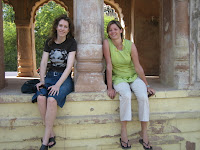
Still, I made it to Lucknow and met with my good friend. Laura and I lived and worked together in Guatemala in 2001 and have only met once since then, so there was a lot of catching up to do. However, we did also find time to do some sight seeing in Lucknow, which is a beautiful city with plenty of old buildings to visit. And except from the fact that the neighbour room in our hotel went up in flames threatening to take us with it (read more about this on Laura´s blog: http://www.magnificentindia.blogspot.com/), it was a wonderful weekend and great to see my good friend again.
 orld’s biggest democracy.
  Luckily, I have a good friend, Laura, who lives in Delhi and we had arranged a weekend trip to Lucknow, a city situated about 200 km. from Nepalgunj.
The trip to Lucknow takes 5 hours in a taxi but before that you have to get past the Indian immigration officer. Those of you who have been to India can probably share a story or two about the Indian bureaucracy and the main character would most likely be a guy like the immigration officer at the Nepalgunj border. Once all my personal data has been recorded in different books and on forms, everything from age, family relations, politics and festival needs to be discussed over a cup of the. Until this often hour long ritual has been seen through you can forget about a stamp in your passport.

My theory is that since only about 500 foreigners cross this border each year, this poor immigration officer gets very lonely and therefore desperately tries to hold on to his “customers” as long as possible!

Still, I made it to Lucknow and met with my good friend. Laura and I lived and worked together in Guatemala in 2001 and have only met once since then, so there was a lot of catching up to do. However, we did also find time to do some sight seeing in Lucknow, which is a beautiful city with plenty of old buildings to visit. And except from the fact that the neighbour room in our hotel went up in flames threatening to take us with it (read more about this on Laura´s blog: http://www.magnificentindia.blogspot.com/), it was a wonderful weekend and great to see my good friend again.
Wednesday, September 19, 2007
Teej – women´s festival

Every September the womens festival Teej is celebrated. Basically it is about women getting to dress up in their beautiful red sari (traditional custome) and dance and sing more or less non-stop in s everal days. However, women also have to fasten for the health of their husband and I have to admit I find it hard to understand the festival part in having your husband get drunk while you are not allowed to eat or drink anything (but of course you still have to cook for the family), and have to stay awake all night to dance in 30 degrees on empty stomach!
No matter what it is a big festival for women here and as adviser to two women organisations there is no way around it. So I fought my way through 4 days of programmes consisting of song- and dance competitions, visits to colleagues and lots of comments on why I had chosen not to wear a red Sari!!!
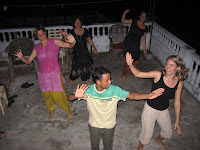
To start of Teej I had asked a dance instructor to come to my house and teach me and some colleagues from MS. I must admit that I will probably never learn Nepali dance, but it never hurts to try... and us girls were lucky enough to have Jakob on stand-by to make sure that there was plenty of cold beer to get us through the dance lesson.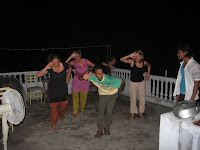
 everal days. However, women also have to fasten for the health of their husband and I have to admit I find it hard to understand the festival part in having your husband get drunk while you are not allowed to eat or drink anything (but of course you still have to cook for the family), and have to stay awake all night to dance in 30 degrees on empty stomach!
No matter what it is a big festival for women here and as adviser to two women organisations there is no way around it. So I fought my way through 4 days of programmes consisting of song- and dance competitions, visits to colleagues and lots of comments on why I had chosen not to wear a red Sari!!!
To start of Teej I had asked a dance instructor to come to my house and teach me and some colleagues from MS. I must admit that I will probably never learn Nepali dance, but it never hurts to try... and us girls were lucky enough to have Jakob on stand-by to make sure that there was plenty of cold beer to get us through the dance lesson.


Thursday, August 09, 2007
Radio talk
Last week my car was on national television and this week I am interviewed for a local radio station – the things one doesn´t do to promote MS Nepal.
It all started with a call from Herman, a guy from a local radio station asking me if I am interested in participating in a radio programme on women´s participation in the Constituency Assembly Election. Thinking this is just a random idea I said that it sounds like an interested programme. The next things I was told was to be in the studio for recording 20 min. later. So I had no choice than to jump on the motorbike and drive the 15 km. to the studio.
Despite limited vocabulary in Nepali I believe I did manage to say one or two things about women´s participation in democracy that did make a bit of sense. At least my colleague, Ishwori, who was with me and luckily did most of the talking, was just as excited about my performance as Herman. So who knows, maybe this wasn´t the last time I will be speaking my mind on Nepali radio.

It all started with a call from Herman, a guy from a local radio station asking me if I am interested in participating in a radio programme on women´s participation in the Constituency Assembly Election. Thinking this is just a random idea I said that it sounds like an interested programme. The next things I was told was to be in the studio for recording 20 min. later. So I had no choice than to jump on the motorbike and drive the 15 km. to the studio.
Despite limited vocabulary in Nepali I believe I did manage to say one or two things about women´s participation in democracy that did make a bit of sense. At least my colleague, Ishwori, who was with me and luckily did most of the talking, was just as excited about my performance as Herman. So who knows, maybe this wasn´t the last time I will be speaking my mind on Nepali radio.
Water and water and water and…..
 Finally, the rainy season came and with that lots of water. As you have probably seen on TV South Asia is severely affected and the Southern part of Nepal has also seen serious flooding. In Banke district, in which I live, 42,000 people (of a population of 150,000) are affected. Also the paddy fields have been emptied after the flooding most likely resulting in a shortage of food in the spring.
I got an extremely bad start to the flooding. On the first day of the flooding I managed to drive my car into a
 ditch that I simply couldn´t see due to the 40 cm. of water on the road. It turned out to be quiet a show with UN car and a tractor trying to get my car out. In the end it took a crane from the Department of Roads to save my car from drowning.
Nepalgunj was completely flooded for 5 days with very limited mobility unless walking in 4 feet high dirty, polluted water seemed appealing. We went for 8 days without electricity and clean water and I certainly came to realize just how dependant I have become on my mobile, laptop, refrigerator and taps with water coming out of….


Thursday, June 28, 2007
Nepalipan
I just saw this little article in a newspaper and found it worth sharing:
Nepalipan
To be Nepali, you need Nepalipan. But what constitutes nepalipan? What is this thing? Talking over with friends on evening we agreed that, in this age of globalization, cuisine, lifestyle and even dress code are becoming uniform, and so cannot hold the essence of nepalipan. We concluded the following: nepalipan is a set of unique characteristics that cannot be found in others. These are typical ways of being that do not change. These are some of the behaviours that we see as constituting nepalipanÆ
Hawking: Nepalis will noisily clear their throats at all times – while brushing, washing up, after a meal, and old time. No one can work their phlegm like a Nepali
Spitting: Everyone spits. But unlike all the rest, Nepalis do it in all places and at all times.
Smoking and riding: Lightning a cigarette and then zooming off on your motorcycle is definitely an indicator of nepalipan. But pedaling a bicycle and synchronously puffing away is an even more fundamental part of nepalipan.
Honking: Every vehicle has a horn that has to be used at times. But Nepali hand work a horn near-incessantly.
Queue-jumping: The English taught the world how to wait in line. But Nepal has never been colonized and we refuse to follow that English teach. To cut in line is not rudeness here, it´s a cunning move.
Overtaking: the free Nepali spirit does not care whether this is done from left or right
Hurrying: Who isn´t rushing about these days? But while others dash around with purpose, Nepalis, uniquely, do it with none. We shove other people while walking for example, and don´t even talk about motorbikes – ever seen on that can idle for a minute?
Nepalipan
To be Nepali, you need Nepalipan. But what constitutes nepalipan? What is this thing? Talking over with friends on evening we agreed that, in this age of globalization, cuisine, lifestyle and even dress code are becoming uniform, and so cannot hold the essence of nepalipan. We concluded the following: nepalipan is a set of unique characteristics that cannot be found in others. These are typical ways of being that do not change. These are some of the behaviours that we see as constituting nepalipanÆ
Hawking: Nepalis will noisily clear their throats at all times – while brushing, washing up, after a meal, and old time. No one can work their phlegm like a Nepali
Spitting: Everyone spits. But unlike all the rest, Nepalis do it in all places and at all times.
Smoking and riding: Lightning a cigarette and then zooming off on your motorcycle is definitely an indicator of nepalipan. But pedaling a bicycle and synchronously puffing away is an even more fundamental part of nepalipan.
Honking: Every vehicle has a horn that has to be used at times. But Nepali hand work a horn near-incessantly.
Queue-jumping: The English taught the world how to wait in line. But Nepal has never been colonized and we refuse to follow that English teach. To cut in line is not rudeness here, it´s a cunning move.
Overtaking: the free Nepali spirit does not care whether this is done from left or right
Hurrying: Who isn´t rushing about these days? But while others dash around with purpose, Nepalis, uniquely, do it with none. We shove other people while walking for example, and don´t even talk about motorbikes – ever seen on that can idle for a minute?
Thursday, June 21, 2007
A year older...
...and also this year it was celebrated outside Denmark and far from family and old friends. But luckily, I have a bunch of new friends who were more than willing to celebrate just the way I like it.
Saturday I had a big party on my roof top:
Saturday I had a big party on my roof top:


Monday I got Tika, cake and presents on MS country office in Kathmandu:

Monday evening I had dinner with friends on a really nice restaurant in Kathmandu:

And now I am a year older……which was felt Tuesday morning!!!
Wednesday, June 20, 2007
Memory lane
This is not my first time in South Asia and my last two holidays were actually spent going down memory lane.
Annapurna Circuit
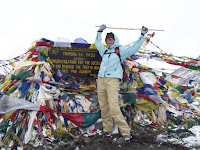
Now you cannot live in Nepal without a trip to the Himalayas. Last time I visited Nepal I went on the Annapurna Circuit – a 21 day trek crossing a mountain pass in 5.416 meters. This April I went on the Circuit once again. It was still a wonderful trip but a bit different this time partly because I was there late in the year and because road construction is taking place in many parts of the trek – yes, it is hard to stop that development. Still, an amazing trip that I really enjoyed – I will let the pictures speak for themselves.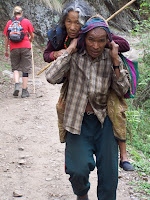



Annapurna Circuit
Now you cannot live in Nepal without a trip to the Himalayas. Last time I visited Nepal I went on the Annapurna Circuit – a 21 day trek crossing a mountain pass in 5.416 meters. This April I went on the Circuit once again. It was still a wonderful trip but a bit different this time partly because I was there late in the year and because road construction is taking place in many parts of the trek – yes, it is hard to stop that development. Still, an amazing trip that I really enjoyed – I will let the pictures speak for themselves.


Dhaka round-trip
Due to an exceptionally cheap plane ticket and some friends left in town I went to Dhaka, Bangladesh for a few days of R & R. It was great to see the city and the friends again. People had gotten married – some willingly and others not – and babies had arrived. I also made it just in time for a going-away-party, so it seemed like last minute I came back. I will share only one (out of the three) pictures from my trip: one of a happy and long anticipated moment where I have some delicious sushi.
Due to an exceptionally cheap plane ticket and some friends left in town I went to Dhaka, Bangladesh for a few days of R & R. It was great to see the city and the friends again. People had gotten married – some willingly and others not – and babies had arrived. I also made it just in time for a going-away-party, so it seemed like last minute I came back. I will share only one (out of the three) pictures from my trip: one of a happy and long anticipated moment where I have some delicious sushi.
Monday, June 04, 2007
A week at DWO
Though I spent much time behind the desk still, some time is spent on different activities with our women groups. Some of which can be quite long –especially in this heat and everything being in Nepali – but mostly it is just great to get to spent time with the women I work for and try to support in their battle for a better future for them and their family.
This week has been particularly full of meetings and programmes so much that it deserves a spot in the blog:
Nepals first Dalit women co-operative
DWO Bankes women groups have just formed and registered the first Dalit women co-operative in Nepal. In this connection, a General Assembly was in order with the 70 members and special guest (including me) participating. There was election for the board and lots of speeches followed by some fun, joking and snacks. It all ended with the mandatory group photo in front of the office. PMC meeting
I most development organisations in Nepal a PMC – Programme Management Committee – exists an d of course DWO is no exception. Every quarter there is a meeting where the different activities are being discussed. The PMC consists of different representatives from staff and board as well as 4 members from our women groups. It is a good forum for them to influence our and it is part of their responsibility to visit the many women groups to get their comments on our work especially the training we provide to them. During this weeks meeting there were several things to be discussed amongst these the newly signed 3-year partnership agreement between DWO and MS Nepal. The PMC needed to be informed of the details of the agreement and the next years (2064) activities and budget. The agreement was thoroughly studied by the group members (see pix) and we received several comments. Since we just star
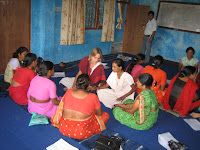 ted ten new groups the "old" groups were a bit unhappy with the huge amount of training given to "the new ones". On top of this we were told not to arrange any training during June and July, since these are the months were the women are most busy in the paddy field planting rice.
After this discussion it was no time to elect new members for the PMC. It is a sough after spot for these women, since it gives prestige and influence on the work of DWO. There were many discussions and deal made here and there; some would only support ones, if promised their support in next years election etc. I tried to mediate the process but the women were doing just fine.
Visit to a women's group
I very often go to visit our women groups and the visit mostly follow the same pattern, so here are the main features:
This week has been particularly full of meetings and programmes so much that it deserves a spot in the blog:
Nepals first Dalit women co-operative
DWO Bankes women groups have just formed and registered the first Dalit women co-operative in Nepal. In this connection, a General Assembly was in order with the 70 members and special guest (including me) participating. There was election for the board and lots of speeches followed by some fun, joking and snacks. It all ended with the mandatory group photo in front of the office.
PMC meetingI most development organisations in Nepal a PMC – Programme Management Committee – exists an
 d of course DWO is no exception. Every quarter there is a meeting where the different activities are being discussed. The PMC consists of different representatives from staff and board as well as 4 members from our women groups. It is a good forum for them to influence our and it is part of their responsibility to visit the many women groups to get their comments on our work especially the training we provide to them. During this weeks meeting there were several things to be discussed amongst these the newly signed 3-year partnership agreement between DWO and MS Nepal. The PMC needed to be informed of the details of the agreement and the next years (2064) activities and budget. The agreement was thoroughly studied by the group members (see pix) and we received several comments. Since we just star
 ted ten new groups the "old" groups were a bit unhappy with the huge amount of training given to "the new ones". On top of this we were told not to arrange any training during June and July, since these are the months were the women are most busy in the paddy field planting rice.
After this discussion it was no time to elect new members for the PMC. It is a sough after spot for these women, since it gives prestige and influence on the work of DWO. There were many discussions and deal made here and there; some would only support ones, if promised their support in next years election etc. I tried to mediate the process but the women were doing just fine.
Visit to a women's group
I very often go to visit our women groups and the visit mostly follow the same pattern, so here are the main features:
(you can read about Tika elsewhere on this blog)


Informal talk with villagers (I am not exactly
able to "disappear in the crowd" and just
leave after a visit)


Moving things from the road so the car
can get through....
Having snacks with the colleagues discussing the group visit

Sunday, April 22, 2007
New year – new experiences
Finally we entered a new year here in Nepal – more precisely the year 2064.  And it seems to be a really exciting year.
Work has finally kicked off leaving me with plenty of exciting tasks. After a long time as an observer I now feel like I am able to contribute to the de velopment of the two organisations and their work.
Also the language I am starting to master quite well, which certainly has made life a lot easier for me. I am still struggling with the alphabet but have accomplished to write small notes to my cleaning lady – some of which she actually understood.
Finally, my social life as taken an unexpected turn; as part of the peace process and upcoming election Nepal has asked the UN for assistance. And it certainly has arrived now. In my town around 40 new UN people have arrived. Some to support the election commission but most of them to m onitor the arms management of the Maoist guerrilla army and th
 e Nepali army as well. It is a mixed group from the Middle East, Afrika, Latin America and Europe. They spend a lot of time in the Maoist camps but whenever they are in Nepalgunj, they enjoy plenty of football and parties – some of my favorite hobbies as well.
Also on new years eve these festive guys arranged a BBQ prepared on the remains of a satellite disc by a guy from Paraguay – and what a party.
Yes, 2064 will for sure be an exciting new year.
 And it seems to be a really exciting year.
Work has finally kicked off leaving me with plenty of exciting tasks. After a long time as an observer I now feel like I am able to contribute to the de
 velopment of the two organisations and their work.
Also the language I am starting to master quite well, which certainly has made life a lot easier for me. I am still struggling with the alphabet but have accomplished to write small notes to my cleaning lady – some of which she actually understood.
Finally, my social life as taken an unexpected turn; as part of the peace process and upcoming election Nepal has asked the UN for assistance. And it certainly has arrived now. In my town around 40 new UN people have arrived. Some to support the election commission but most of them to m
 onitor the arms management of the Maoist guerrilla army and th
 e Nepali army as well. It is a mixed group from the Middle East, Afrika, Latin America and Europe. They spend a lot of time in the Maoist camps but whenever they are in Nepalgunj, they enjoy plenty of football and parties – some of my favorite hobbies as well.
Also on new years eve these festive guys arranged a BBQ prepared on the remains of a satellite disc by a guy from Paraguay – and what a party.
Yes, 2064 will for sure be an exciting new year.
Subscribe to:
Posts (Atom)